
Money explainer
Budgeting without surveillance: share finances without oversharing
How couples and roommates can get clarity and reduce fights while keeping healthy privacy boundaries.
Stitch Money Editorial Team · Published March 5, 2026
Editorial policy and correction standards
- Separate useful visibility from controlling oversight
- Use simple privacy rules for shared money conversations
- Build a household system that improves clarity without erasing boundaries
A lot of household budgeting advice quietly assumes that more visibility is always better. That's not true. Good financial collaboration is about enough visibility to manage shared decisions, not about turning every private purchase into an open file.
That's why budgeting without surveillance matters. Couples and roommates can absolutely reduce confusion and fewer money fights without building a system that feels like one person is monitoring the other.
Visibility versus control
Visibility is about seeing what the household needs in order to plan shared bills, goals, and timing. Control is what it feels like when the tool becomes a way to inspect or police behavior that doesn't actually require shared review.
The difference isn't theoretical. It shows up in what gets shared, how often it gets discussed, and whether the process is built for coordination or for scrutiny.
Couples and roommates need different boundaries
Couples often want more shared context around recurring bills, long-term goals, and household cash flow, but still may not want every personal discretionary purchase treated like a committee decision. Roommates usually need an even narrower shared layer focused on rent, utilities, and reimbursements.
The right boundary depends on the relationship, but the same principle holds: share what the household genuinely needs, not everything by default.
Why healthy privacy rules reduce fights
Money fights often grow when the scope of visibility is unclear. One person thinks the tool is for shared bills; the other person starts using it to comment on unrelated personal behavior.
A short set of privacy rules lowers the emotional temperature because everyone knows what belongs in the shared conversation and what doesn't.
What a practical shared system looks like
A healthy setup usually shares recurring household bills, upcoming due dates, and the shared cash picture. It leaves personal-only categories outside the main household review unless both people explicitly want more overlap.
That keeps the benefits of clarity while preserving the sense that each person still has a normal financial boundary, not an always-on monitor.
A simple privacy-rules checklist
- Decide which categories and bills truly require shared visibility before linking accounts.
- Keep the shared review focused on obligations, timing, and goals rather than personal judgment.
- Agree on what stays personal unless both people choose to widen the scope later.
- Revisit the rules when the household setup changes instead of only after a conflict.
Helpful next reads
Two setups that create clarity without oversharing
Example 1: Couple sharing household obligations, not every purchase
A couple shares visibility into $2,240 of household bills, groceries, and goal transfers, but personal hobby spending and gifts stay outside the weekly shared review. The shared system answers the household questions without turning every line item into commentary.
They get clarity on what affects both people without feeling like the tool exists to monitor personal behavior.
Example 2: Roommates sharing only what actually overlaps
Two roommates share the rent, utilities, and reimbursement flow, but personal dining, shopping, and subscriptions remain private. Their weekly check-in is five minutes and focused only on what affects the apartment.
The shared system stays useful because the scope is narrow and clearly agreed on.
Common mistakes that make shared budgeting feel invasive
- Sharing everything by default and trying to negotiate boundaries only after the tool already feels uncomfortable.
- Using a shared finance workflow to comment on personal spending that doesn't actually affect the household plan.
Pro tips for healthier financial boundaries
- Define the shared layer by purpose: bills, timing, and goals, not by curiosity.
- Keep the check-in short and operational so the tool stays about coordination instead of becoming a running audit.
How Stitch helps households share the right amount, not everything
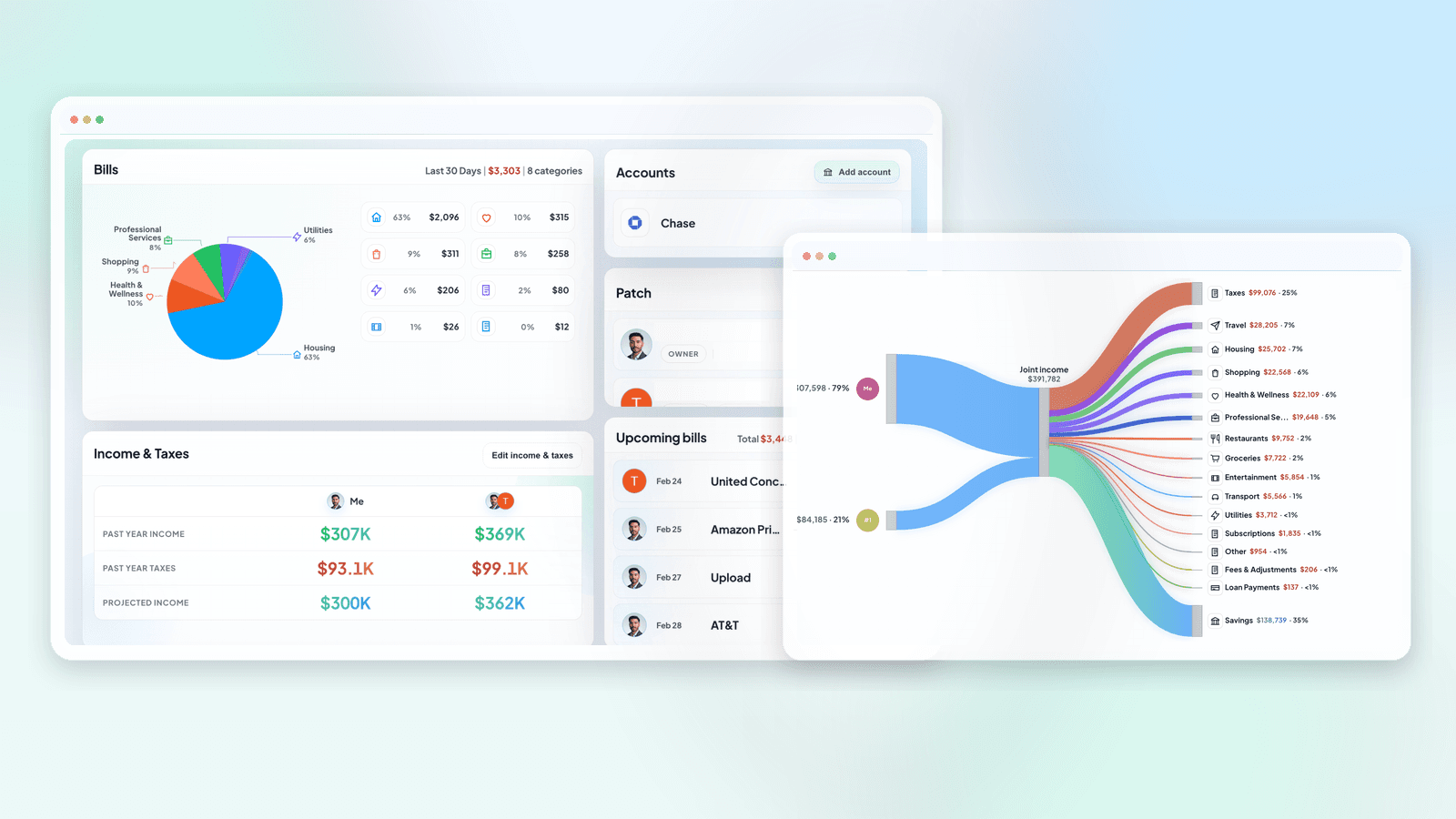
Stitch is built around practical household coordination: recurring bills, shared cash-flow context, transaction review, and Patch for the shared layer. That makes it easier to build visibility around what the household actually needs to manage together.
The point isn't all-or-nothing transparency. It's giving couples and roommates enough shared context to reduce confusion and friction without erasing the privacy boundaries that keep the system healthy.
Frequently asked questions
What does budgeting without surveillance mean?
It means sharing enough financial visibility to manage household decisions without turning the system into a tool for monitoring every personal transaction.
Can couples share finances without seeing everything?
Yes. Many couples only need shared visibility around bills, goals, and cash-flow timing, not every personal purchase.
What should roommates share?
Usually just the overlap: rent, utilities, household supplies, and reimbursements. The scope can stay much narrower than a couple's setup.
Why do money tools sometimes create more fights?
They often create conflict when the scope of visibility is unclear and one person's expectation of 'shared' becomes another person's experience of 'monitored.'
What's the easiest way to set boundaries?
Agree upfront on which bills and categories belong in shared view and keep the weekly review focused on practical household decisions.
How does Stitch help with this?
Stitch supports a household layer through Patch that focuses on shared bills, timing, and planning instead of assuming every financial detail must be visible to everyone.