
Money clarity
A clean system for roommates: bills, groceries, and reimbursements
How to stay friends while splitting utilities and shared expenses.
Stitch Money Editorial Team · Published March 11, 2026
Editorial policy and correction standards
- Assign ownership for every recurring bill
- Use a weekly reimbursement sweep instead of random requests
- Track due dates by account so nothing gets missed
Roommate money tension usually starts small: one utility gets missed, grocery receipts pile up, and nobody is sure who already paid what. The fix isn't a complicated budget. The fix is a repeatable operating system.
A clean roommate system has three parts: recurring bill ownership, shared-spend rules, and a reimbursement cadence. When people search for roommate bill systems, they are trying to protect both cash flow and the relationship.
Start with recurring bill ownership
Give each bill a clear owner who ensures it gets paid: rent, internet, electric, gas, and renter's insurance. Shared responsibility with no owner often means no responsibility.
Ownership doesn't mean one person absorbs the full cost. It means one person handles payment and the split process is predefined.
Choose your split logic once
Most roommates do 50/50 for fixed household bills and a separate rule for variable expenses like groceries and supplies. Pick one model and document it.
If room sizes or incomes differ, use a weighted split for rent while keeping utilities equal. Mixing logic per bill is fine as long as everyone can explain it in one sentence.
Reimbursements should run on a schedule
The fastest way to kill trust is random payment nudges. Use one weekly reimbursement sweep, for example every Sunday night, so no one feels chased daily.
Keep a minimum threshold like $20 before requesting payment to avoid noise from tiny charges.
Due dates matter more than monthly totals
A month can look affordable overall and still fail in week two when three drafts cluster together. Roommates should track bill dates relative to paydays, not only category totals.
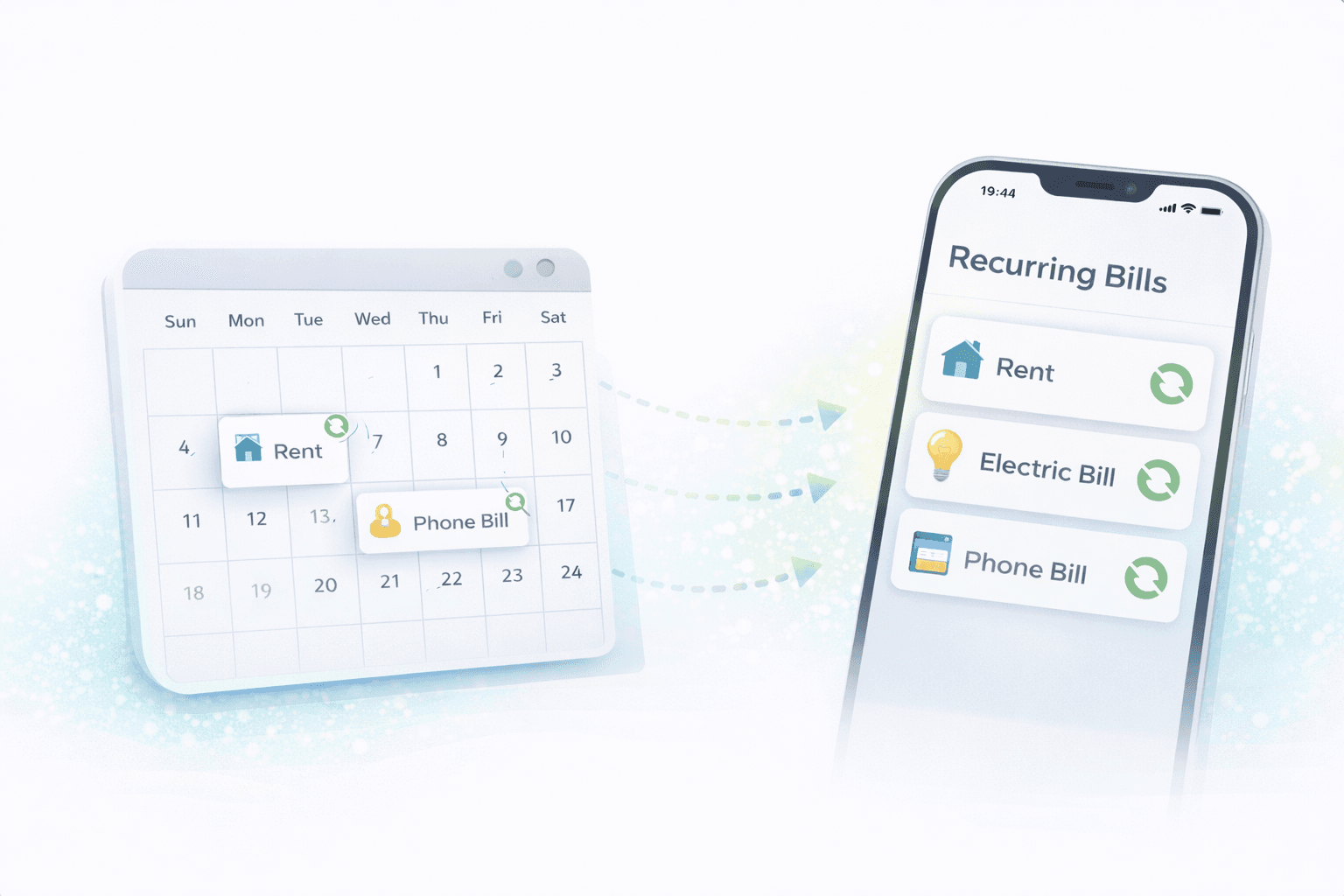
A weekly calendar view helps everyone see what's due next and prevents last-minute Venmo scrambling.
Conflict protocol when someone pays late
Set a default protocol before conflict happens: notice at 48 hours, reminder at 24 hours, and temporary backup payer if needed. Clear process lowers emotional escalation.
The goal is reliability, not punishment. Documenting expectations protects friendships when money is tight.
Roommate setup in one afternoon
- List all recurring household bills with due date and payer owner.
- Pick split formulas for fixed bills and variable spending.
- Set one weekly reimbursement day and preferred payment method.
- Create a late-payment protocol everyone agrees on in writing.
Helpful next reads
Two roommate setups with real numbers
Example 1: Three roommates, equal split
Rent is $2,400, internet $75, electric averages $180, and shared groceries average $420 monthly. Each roommate owns one utility and they reimburse every Sunday for variable purchases above $20.
No one carries hidden balances and monthly reconciliation takes under 10 minutes.
Example 2: Uneven bedrooms, weighted rent
Roommate A has the master and pays 40% of $2,650 rent, while B and C pay 30% each. Utilities and cleaning supplies are split equally. Grocery reimbursements are tracked weekly with receipts tagged as shared.
The unequal housing value is acknowledged without making every category a negotiation.
Common mistakes
- Assuming everyone remembers who paid each bill instead of assigning explicit ownership.
- Settling reimbursements only at month-end, which causes confusion and larger payment shocks.
Pro tips
- Use recurring reminders 3 days before major drafts so backups can be arranged early if needed.
- Keep shared grocery rules simple, like "house staples yes, personal snacks no," to reduce edge-case arguments.
How Stitch helps roommates stay organized
Stitch surfaces recurring charges and upcoming due dates so roommate bills are visible before they become late. Transactions and Spending help verify who paid and what counts as shared.
For households using Patch, everyone can work from the same source of truth instead of scattered screenshots and chat history. That makes reimbursements less emotional and more mechanical.
Frequently asked questions
Should roommates split everything 50/50?
Only if room value and usage are similar. Many households use weighted rent and equal utilities.
How often should reimbursements happen?
Weekly works well because balances stay small and easier to verify.
What if one roommate always pays late?
Use a predefined protocol with reminder timing and backup payment steps, then review the split model if needed.
Do roommates need one shared bank account?
No. Most roommate systems run with separate accounts plus a clear reconciliation process.
How do we handle groceries fairly?
Agree which items are shared and settle shared grocery receipts on a fixed weekly schedule.
What should we do first when bills feel chaotic?
Build a bill ownership list with due dates and account source before touching category budgets.